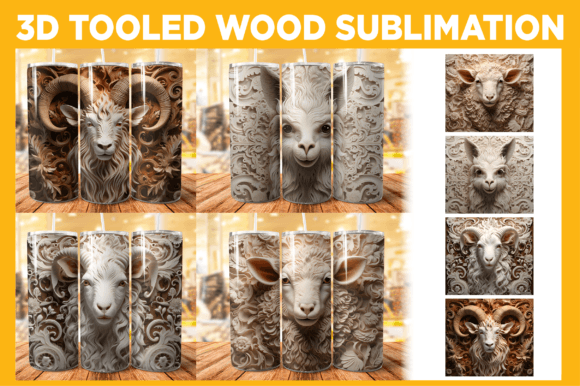
Elevating Custom Drinkware with the 3D Sheep Tooled Leather Tumbler Wrap
In the competitive landscape of custom merchandise and personalized gifts, the difference between a standard product and a bestseller often lies in the texture and depth of the design. For creators, small business owners, and hobbyists looking to expand their catalog, the 3D Sheep Tooled Leather Tumbler Wrap represents a significant opportunity to introduce rustic charm and tactile realism to sublimation projects. This digital asset is not merely an image; it is a foundational component in a broader workflow that transforms blank stainless steel into high-value, artisan-style goods.
Understanding how to integrate this specific design bundle into your production pipeline requires more than just downloading a file. It involves strategic planning regarding file preparation, substrate compatibility, and quality control. Whether you are fulfilling a single order for a friend or scaling up inventory for an online store, the process demands attention to detail to ensure the final output matches the visual promise of the digital preview.
Integrating Digital Assets into Your Production Workflow
The journey begins long before the heat press is heated up. When you acquire a 3D Tooled Leather Wood PNG Bundle, you are adding a versatile resource to your digital library. The immediate step in your workflow should be organization. Upon receiving the 4 PNG files included in the download, store them in a dedicated folder structure that categorizes assets by theme, size, and intended application. This practice prevents version control errors later when you are managing multiple client requests.
The primary file provided is optimized for a Straight 20oz Tumbler Wrap with dimensions of 9.3x8.2 inches at 300 DPI. This resolution is critical for maintaining sharpness during the sublimation process. However, a robust workflow anticipates versatility. Because these files are high-resolution raster images, they can be resized to fit other substrates without significant loss of quality. Before committing to a print run, verify the aspect ratio against your specific tumbler model. While the "skinny" 20oz is the standard target, slight variations in manufacturer specifications can occur. Adjusting the canvas size in your design software to match your specific blank ensures full coverage without unwanted white borders or stretched graphics.
Pre-Press Preparation and Compatibility Checks
Successful implementation relies heavily on the interaction between the digital design and the physical medium. The 3D Sheep Tooled Leather Tumbler Wrap mimics the appearance of tooled leather, a texture that relies on shadow and highlight to create the illusion of depth. To preserve this effect, your printer settings must be calibrated for vibrant color reproduction. Using a color-managed workflow ensures that the rich browns and intricate tooling details seen on your monitor translate accurately to the sublimation paper.
Compatibility extends beyond the printer. The choice of tumbler blank is paramount. For a design that simulates leather, a matte or slightly textured powder-coated blank can sometimes enhance the realistic effect, though standard glossy blanks remain the industry norm for maximum color vibrancy. If you plan to use this design on alternative products mentioned in the bundle description, such as shirts, mugs, or puzzles, you must adjust your heat press settings accordingly. Each substrate has a unique time, temperature, and pressure requirement. Ignoring these variables can result in ghosting, color shifting, or a failure to penetrate the coating, rendering the detailed leather texture flat and lifeless.
Execution: From File to Finished Product
Once the design is printed and trimmed, the assembly phase begins. This is where the practical nuances of using a 20oz Skinny Tumbler wrap come into play. Unlike flat surfaces, cylindrical objects require precise alignment to ensure the pattern flows seamlessly around the curve. The "tooled" aspect of the sheep design implies a continuous texture; if the seam does not align perfectly, the illusion of a wrapped leather hide is broken.
Use heat-resistant tape to secure the sublimation paper tightly against the tumbler. Any air pockets between the paper and the coating will result in blurred areas, which is particularly detrimental to fine details like the tooling marks on the sheep motif. For the 9.3x8.2" wrap, ensure the tension is even from top to bottom. Uneven tension can cause the image to shift during the heating cycle, leading to a skewed final product.
During the pressing cycle, consistency is key. Follow the manufacturer's guidelines for your specific heat press or convection oven. Over-pressing can scorch the coating, while under-pressing leads to dull colors. Given the earthy tones inherent in a leather simulation, monitoring the brown hues is essential; they can easily shift towards orange or red if the temperature spikes. After the cycle completes, allow the tumbler to cool completely before removing the paper. Peeling while hot can damage the fresh image and compromise the durability of the finish.
Expanding Use Cases Beyond Drinkware
While the primary application is the 20oz Skinny Tumbler, a forward-thinking creator leverages assets across multiple revenue streams. The bundle's flexibility allows for integration into diverse product lines. For instance, the same PNG files can be applied to ceramic mugs, offering a matching set for customers. The rustic aesthetic pairs exceptionally well with wooden puzzles or coasters, creating a cohesive "farmhouse" or "western" themed collection.
Furthermore, these designs are suitable for apparel. When transferring the image to fabric, consider the garment color. The leather texture works best on lighter backgrounds where the contrast remains visible, or on specific dark-transfer papers designed for cotton blends. By viewing the 3D Sheep Tooled Leather Tumbler Wrap as a modular design element rather than a single-use graphic, you maximize the return on investment for the digital download.
Quality Control and Long-Term Asset Management
Maintaining high standards requires a rigorous quality control (QC) protocol. Every finished item should be inspected for clarity, color accuracy, and surface smoothness. Pay close attention to the edges of the wrap; any sign of peeling or incomplete transfer indicates a need to recalibrate your equipment or adjust your timing. Consistency builds trust with your clientele. If a customer orders a tumbler today and another next month, the "leather" texture should look identical in both instances.
From a business perspective, documenting your successful settings for this specific design creates a repeatable process. Record the exact time, temperature, and pressure used for the 20oz skinny tumbler, as well as any specific printer profiles. This documentation reduces waste and speeds up future production runs. It also facilitates training if you expand your team or outsource parts of the fulfillment process.
It is important to remember that these are digital downloads; no physical items are shipped. This means the onus is on the creator to possess the necessary hardware and software to unzip and utilize the files effectively. Ensuring your computer systems are updated and capable of handling high-resolution PNGs without lag is part of the technical readiness required for professional results.
Customization and Client Engagement
The true power of this workflow lies in its adaptability. While the base design offers a stunning ready-to-use solution, there is often room for personalization. Adding monograms, names, or dates to the negative space of the leather texture can elevate the perceived value of the item. This level of customization turns a generic product into a bespoke gift, commanding higher price points.
For those seeking something entirely unique, engaging with the designer for custom modifications can open new creative avenues. Many creators offer exclusive perks or the ability to message for bespoke adjustments, allowing you to tailor the 3D Tooled Leather Wood PNG Bundle to specific seasonal campaigns or niche market demands. This collaborative approach fosters a dynamic relationship between the asset provider and the end-user, ensuring that your product line remains fresh and relevant.
In conclusion, the 3D Sheep Tooled Leather Tumbler Wrap is more than a decorative layer; it is a catalyst for efficient, high-quality production. By treating the digital file as a core component of a structured workflow—from organized storage and precise pre-press checks to meticulous execution and rigorous QC—creators can consistently deliver exceptional products. Whether you are a seasoned entrepreneur or a hobbyist refining your craft, mastering the integration of such detailed assets is the key to standing out in the crowded marketplace of custom goods.